
“Disclaimer:Tenant Support UK is not a law firm and does not provide regulated legal advice. All content on this website is for general informational purposes only, based on publicly available legal guidance and personal experience. If you need legal advice tailored to your situation, please consult a qualified solicitor or a trusted housing advice service.“
Understanding the hidden game behind your tenancy agreement
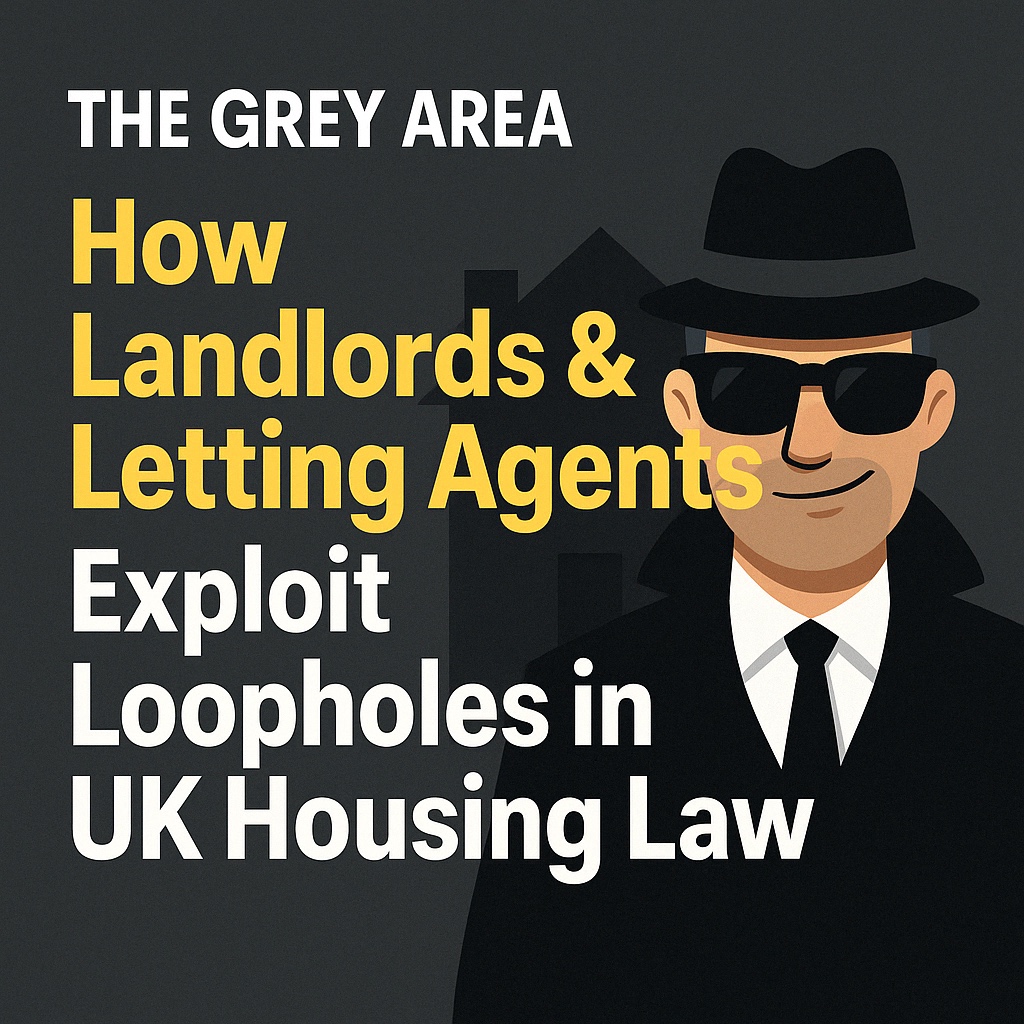
Welcome to the Wild West of Renting:
The UK rental sector is booming, not just with tenants, but with landlords and letting agents who’ve mastered the art of dancing through legal loopholes. For every official regulation, there seems to be a creative workaround. The result? A growing number of renters trapped in barely legal setups that walk the line between shady and outright unlawful.
Let’s lift the curtain, shall we?
The Unlicensed HMO Trick
One of the most widespread loopholes is the unlicensed House in Multiple Occupation (HMO).
Landlords renting to three or more unrelated people must legally license the property. But what happens in the real world?
They may:
Put only one person on the tenancy agreement.
Collect rent individually from the others.
Call the rest “guests” or “lodgers”, even when they’ve lived there for months, paid bills, and have keys.
This tactic allows landlords to avoid council inspections, licensing fees, safety requirements, and accountability.
Letting Agents: The Invisible Hands
Letting agents often operate as middlemen, but many act with little transparency.
They may:
Collect deposits without protecting them.
Avoid giving receipts or contracts.
Communicate only through WhatsApp, ignoring formal communication channels.
When things go wrong, agents blame the landlord, and landlords blame the agent. Tenants are caught in the crossfire of an accountability black hole.
The “Fixed-Term Expiry” Shuffle
Landlords and agents often refuse to formally evict tenants when disputes arise. Instead,
they may:
Wait for a fixed-term tenancy to expire.
Avoid renewing.
Pressure tenants to leave by text, verbal threats, or by ignoring repair requests.
Because it’s not a formal eviction, they avoid legal proceedings, court orders, and due process, yet they still manage to regain possession.
The Grey Rent Economy
Some landlords collect rent informally, directly into personal accounts, or even in cash, avoiding taxes and hiding income. But tenants who later try to prove residency, for benefits, council tax, or even legal claims, suddenly find “no record” of their tenancy.
Tenants who ask for official agreements or protection get told:
“Don’t make this complicated, or we’ll find someone else.”
Emotional Support Animals: Discretionary Rights Exploited
While assistance dogs for physical impairments are protected by law, emotional support animals fall into a legal grey area.
Some landlords exploit this by:
Outright refusing reasonable requests, even in severe mental health situations.
Threatening eviction or raising rent as retaliation.
Allowing pets for themselves, but banning them for tenants.
Without clear law, tenants are left to plead, not assert, their needs.
When Repairs Become a Weapon
Deliberate disrepair is a silent tool of manipulation.
Landlords:
Delay essential repairs to pressure tenants to move.
Only act once councils intervene, often too late.
Claim damage is caused by tenants, then deduct from deposits.
Some even send contractors with no warning, or none at all breaching quiet enjoyment rights.
Blurred Lines: “Not My Tenant” Excuse
A particularly grim tactic used by rogue landlords and agents is denying legal responsibility for tenants altogether.
They may say:
“You’re not on the tenancy, you’re not our problem.”
But they may have :
Cashed rent from the tenant.
Knew the tenant lived there.
Arranged repairs, utilities, even viewings, directly with them.
When it suits them, the tenant exists. When it doesn’t? They vanish into the grey.
The Grey Area might be Designed to Confuse You
These tactics are not just mistakes. They’re part of a system that thrives on confusion, informality, and fear.
The grey zone in UK housing law is wide and too many landlords and agents walk it like a catwalk.
Tenants deserve clarity.
They deserve protection.
And they deserve to know the rules, even if others refuse to follow them.
The Toolbox: 9 Ways to Fight Back Without Moving to Mars
- Shelter England – england.shelter.org.uk — 0808 800 4444.
- Citizens Advice Redditch & Bromsgrove – citizensadviceredditch.org.uk.
- TSUK Letters Templates – TenantSupportUK.com
- ACORN Community Union – acorntheunion.org.uk.
- Generation Rent – generationrent.org.
- Renters Reform Coalition – rentersreformcoalition.co.uk.
- Housing Ombudsman Service – housing-ombudsman.org.uk.
- Redditch Borough Council Housing Solutions – redditchbc.gov.uk/housing or call 01527 587 000.
- Tenancy Deposit Schemes – depositprotection.com (DPS) • tenancydepositscheme (TDS) • mydeposits.co.uk (MyDeposits)
Tenant Support UK





 Tenant Support UK
Please, leave your comment here